
Behind the Curtain Response Bulletin
Posted on June 9, 2026 by Curt Candid in Category: News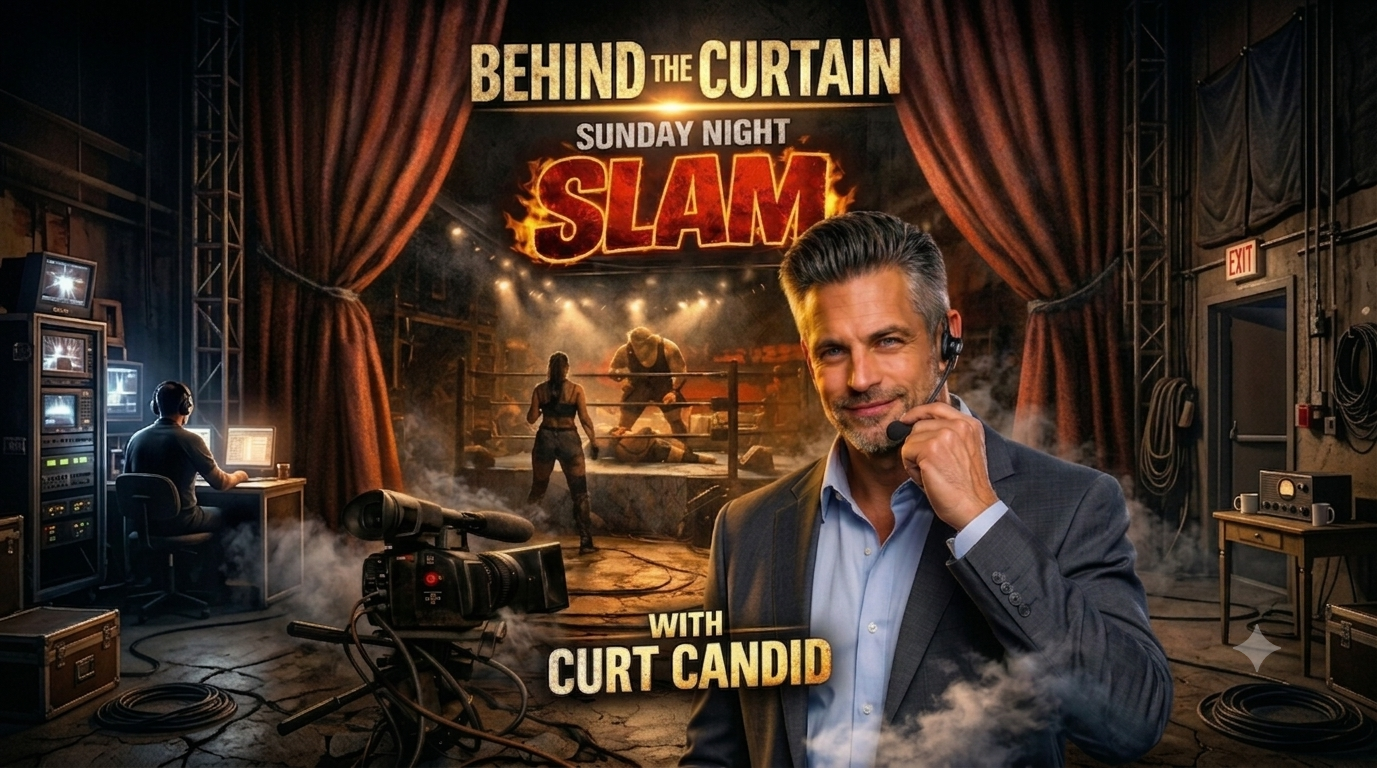
First of all, yours truly, Curt Candid doesn’t read columns. He audits them.
That’s the first thing you need to understand before you try to swing a sword in my direction, Masked Muchacho. You wrote with passion, with clarity, with a kind of moral urgency that plays beautifully to a crowd that still wants to believe the ring is a church and not a stage. I respect that instinct. I even admire it.
But admiration is not agreement.
And what you dropped wasn’t a sword.
It was a flare.
“The Pen Was Never Hidden”
By Curt Candid, Lead Writer, Sunday Night SLAM
I’m glad you put the torta down.
Not because of what you wrote — we’ll get to that — but because moments like that matter. The pause. The recognition. That flicker of “oh, this is bigger than I thought it was.” You felt it. You admitted it. That’s more honesty than most people in this business can muster even when it’s scripted for them.
You recognized what I was doing.
You just don’t like what it means.
Let’s strip this down to its bones, since you seem so eager to talk about architecture.
You said I didn’t write a column about Episode 5.
Correct.
I wrote about what Episode 5 is.
Not the sequence of moves. Not the crowd reactions. Not the sanitized highlight reel version of events that lets everyone walk away feeling like the universe is fair and outcomes are earned in a vacuum.
I wrote about authorship.
Because whether you want to admit it or not — whether the fans in your Discord want to admit it or not — authorship is the only thing that has ever mattered in this business.
You draw a line between writer and participant like it’s sacred.
It isn’t.
It’s convenient.
That line exists so people can enjoy the illusion of purity. So a champion can hold a belt and say “I earned this” without interrogating who decided the opportunity existed in the first place. So a move can feel decisive without questioning who protected it, who built it, who chose the moment it would land and matter.
You call me an active participant like it’s an accusation.
I call it honesty.
Because I didn’t become a participant when I sat at ringside.
I’ve always been one.
I just stopped pretending otherwise.
And that — more than anything — is what unsettled you.
Not Jessica losing.
Not the sentence you keep replaying like it’s a confession carved into stone.
“The ending belonged to me before the bell ever rang.”
You’re treating that like a scandal.
It’s not a scandal.
It’s a statement of function.
Endings always belong to someone before the bell rings. Always. The difference is that most of the time, that someone hides behind layers of production meetings, agent notes, collaborative language, and plausible deniability.
I removed the camouflage.
And suddenly the same machine you’ve celebrated, analyzed, and quite literally built a championship identity around… feels dangerous to you.
That’s not because I changed the system.
It’s because I made you see it.
Now let’s talk about the part you really wanted to talk about — even if you dressed it up in concern for “the foundation.”
Jessica Shimmer.
You framed her as a victim.
That’s neat. It’s clean. It plays well.
It’s also incomplete.
Jessica Shimmer stepped into that match knowing exactly what this business demands. Taped ribs and all. She didn’t walk in blind. She didn’t wander into a trap set by a bitter ex-husband twirling a pen like a mustache.
She walked into a narrative.
A brutal one. A necessary one. One that required her to be exactly what she was in that moment — resilient, explosive, defiant… and ultimately, not enough.
You think that diminishes her?
It defines her.
Loss, when it’s placed correctly, is not burial. It’s architecture. It’s load-bearing. It creates tension, trajectory, consequence. The very things you claim to value when you talk about championships meaning something.
But meaning doesn’t come from randomness.
It comes from design.
And yes — I designed it.
Not because of a grudge.
Not because of some cartoonishly petty desire to “control” her.
But because that outcome served the story we are telling at a level bigger than one match, one relationship, or one moment that made you uncomfortable while eating a sandwich.
You want to talk about darkness?
Here’s the darker truth.
You’ve built your identity — your championship — on analyzing a system you never had to take responsibility for.
You get to react.
You get to critique.
You get to swing after the fact and call it righteousness.
I don’t have that luxury.
Every decision I make lands on someone’s body. On someone’s momentum. On someone’s place in the ecosystem you claim to defend.
And I sign my name to it.
Publicly.
Consistently.
Without a mask.
So when you position yourself as the guardian of “realness,” understand what you’re actually protecting:
Not truth.
Comfort.
The comfort of believing that outcomes emerge organically. That no one is steering the ship in ways that might make you question your emotional investment.
I broke that comfort.
Deliberately.
Because Sunday Night SLAM doesn’t need another echo chamber of safe reactions and neatly packaged recaps.
It needs stakes that extend beyond the ropes.
It needs friction.
It needs — whether you like it or not — someone willing to say “this matters because I made it matter.”
Now, you issued a challenge. Not in so many words, but let’s not pretend otherwise.
“You’re going to have to write around me.”
That’s what you said.
And that’s where this gets interesting.
Because you’re right about one thing:
You matter.
The Internet Championship matters. Your voice matters. Your presence in this ecosystem — this ongoing conversation between creation and reaction — absolutely has weight.
But here’s where you misunderstand your role.
You don’t stand outside the fire.
You feed it.
Every column you write, every doubt you amplify, every question you put into the bloodstream of the audience — that shapes perception. And perception shapes value. And value shapes everything that follows.
You’re not opposing the pen.
You’re another instrument of it.
Just one that prefers to believe it’s independent.
So no, I’m not going to “write around you.”
I’m going to write through you.
Through your objections. Through your suspicion. Through your very public discomfort with the idea that the system you champion has a visible hand guiding it.
Because that tension?
That’s money.
That’s narrative.
That’s the next evolution of what this can be when we stop pretending the curtain is sacred and start treating it like what it actually is:
A tool.
You said you have the best seat in the house.
Good.
Stay there.
Watch closely.
Keep writing.
Keep questioning.
Keep putting down tortas at midnight because something you read made you feel like the ground shifted under your feet.
Because as long as you’re doing that, you’re exactly where I need you to be.
Not outside the architecture.
Inside it.
— Curt Candid
Lead Writer, Sunday Night SLAM
“Behind the Curtain”