
Behind the Curtain — Special Response “Receipts in Blood and Ink”
Posted on June 9, 2026 by Curt Candid in Category: News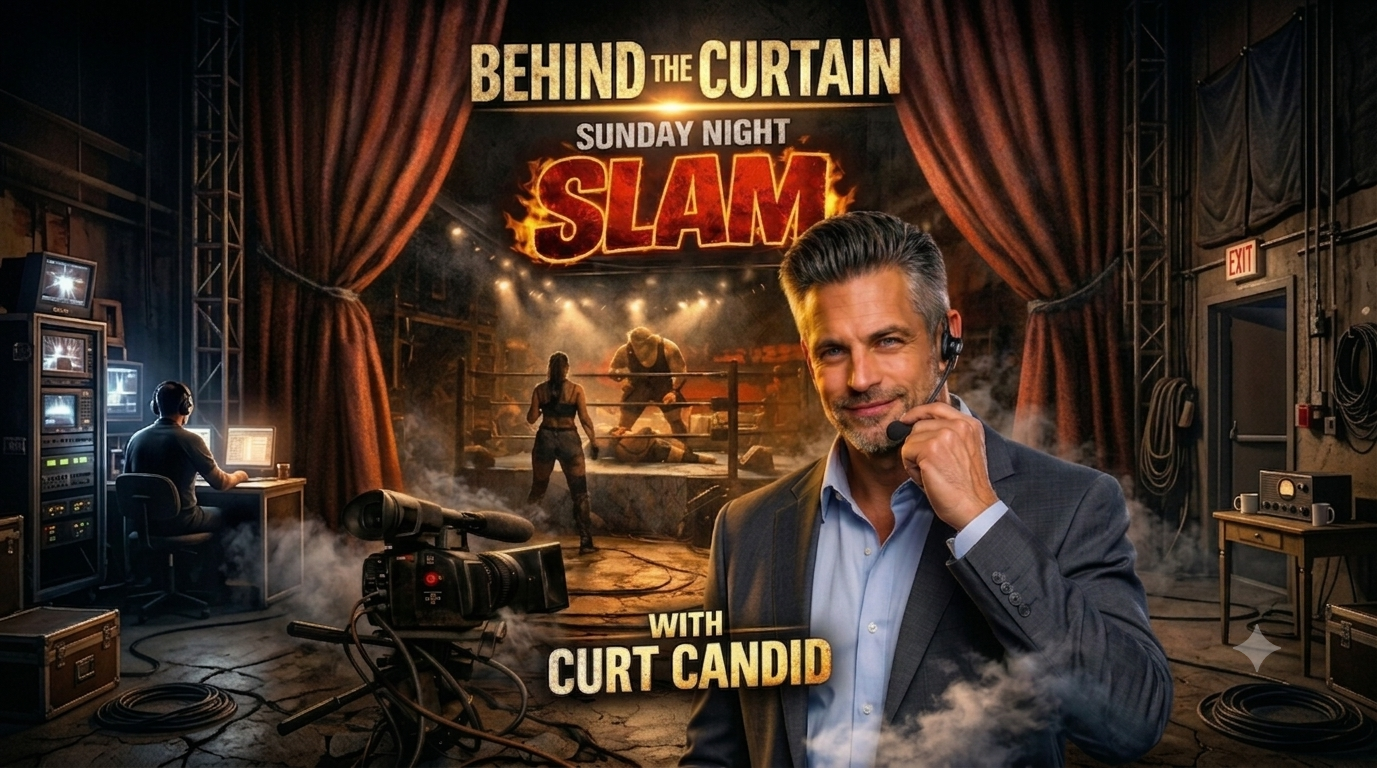
By Curt Candid, Lead Writer, Sunday Night SLAM
Marshal Hardcastle doesn’t like mirrors.
That’s the first thing I took from your little sermon, Marshal—not the volume, not the bluster, not the charming fixation on my breakfast habits—but the very specific, almost allergic reaction you had to the idea that someone might describe the machine instead of just revving the engine.
You don’t hate what I wrote.
You hate that I said it out loud.
Because for a man who claims to deal exclusively in “reality,” you spent an awful lot of time shadowboxing with something you insist doesn’t exist.
Let’s get something clean between us before you start swinging haymakers at ghosts:
You are not the antidote to what I do.
You are the other half of it.
You just wear denim instead of silk.
You built your entire response around a premise that sounds rugged, marketable, and wonderfully chantable in a Southern arena:
“We don’t script it. We live it.”
That’s a hell of a T-shirt.
It’s also a lie.
Not because your matches lack impact. Not because your locker room isn’t full of legitimate killers who would happily rearrange someone’s dental work for a better payday.
But because the second you said the words “I’m running a three-hour gauntlet of episodic television,” you told on yourself.
You’re not running a bar fight.
You’re running a show.
A structured, timed, advertiser-conscious, segment-blocked, camera-produced show.
That’s not chaos.
That’s orchestration with a southern accent.
And the only difference between you and me is that I don’t pretend the orchestra plays itself.
Let’s go piece by piece, since you were kind enough to try and audit my work like a man flipping over a poker table because he doesn’t like the dealer.
You called The Made Men a “mugging.”
Good.
It was.
That’s the point.
Violence, Marshal, is not automatically meaningful just because it’s loud or stiff or leaves a bruise that looks good in a locker room mirror. Violence becomes meaningful when it communicates hierarchy.
The Made Men didn’t just beat Degeneration HEX.
They clarified the food chain.
You see “string-bean kids.”
I see variables—interruptions in a system—that needed to be resolved decisively so that when real threats emerge, the audience understands exactly how dangerous the environment has become.
You want beer cans thrown?
I want silence.
Because silence means they’re paying attention.
Silence means they understand something just shifted.
You chase noise.
I engineer memory.
Leo Maximus.
You called him a coward.
Of course you did.
Men like you always do.
Because Leo represents something your philosophy can’t process: survival without apology.
You want grit? He has it.
You just don’t recognize it because it doesn’t come wrapped in calluses and denim.
Maximus is what happens when instinct evolves past brute force. He doesn’t need to prove he’s the toughest man in the room.
He needs to leave the room with the win.
You call it cowardice.
I call it efficiency.
And more importantly?
The audience will remember how he made them feel.
Not how hard he hit.
Ricky Inoki and Leo Anderson.
You dismissed it as repetition.
A memo already read.
That’s interesting, because what you call repetition, I call reinforcement.
You don’t build stars by accident, Marshal.
You build them by layering outcomes until the audience has no choice but to accept what they’re seeing as inevitable.
You’re waiting for a tendon to snap to prove something matters.
I’m teaching the audience what matters before the tendon ever becomes part of the conversation.
That’s the difference between escalation and dependency.
You need the injury.
I need the implication.
Now let’s get to the part where your voice got a little sharper.
A little more personal.
Jessica Shimmer.
You called it therapy.
That’s convenient.
That’s also cowardly.
Because reducing that match to “divorce drama” lets you avoid engaging with what actually happened in that ring.
Jessica wasn’t diminished.
She was revealed.
And Big Mama Johnson didn’t “drop weight for cheap heat.”
She proved gravity is undefeated.
That match wasn’t about my relationship.
It was about consequence.
Jessica made a choice to fight upward, injured, defiant, pushing against something bigger than her.
And she lost.
Not because I needed catharsis.
But because the story demanded truth.
And truth, Marshal, doesn’t always look like a heroic comeback.
Sometimes it looks like the mat rushing up faster than you expected.
You invoked Bill Watts.
You invoked Mid-South.
You invoked this romantic, dirt-under-the-fingernails mythology of a business where men were men and outcomes were decided in some pure vacuum of toughness.
Let me ruin that fantasy for you in one sentence:
Those territories were controlled by men exactly like me.
The difference?
They didn’t have to explain themselves.
You benefit from their mystique while pretending you’re not doing the same job.
You are.
You just package it differently.
You sell “real.”
I sell “honest.”
And honest is far more dangerous.
You warned me about a locker room revolt.
That’s my favorite part.
Because it tells me how you see the people under your watch.
You think they’re going to wake up one day and realize they’re “bleeding while I take credit.”
Marshal, they already know.
Every single person who steps into that ring on Sunday Night SLAM understands the exchange.
They bring the physical risk.
I bring the narrative weight that makes that risk matter beyond the moment.
Without them, I have nothing.
Without structure, they have noise.
We are not in opposition.
We are in alignment.
The revolt you’re predicting?
That happens in systems where people are lied to.
Not where the terms are clear.
And that brings us to Friday Night FURY.
Your crown jewel.
Your demolition derby.
Your rolling cathedral of “unscripted” violence that just so happens to hit commercial breaks on time and build perfectly to a main event segment designed to keep viewers through the final quarter hour.
You’re proud of your chaos.
You should be.
It sells.
But don’t confuse volatility with control.
Because what you call “uncontained disaster” is still contained by you.
You decide who gets time.
You decide who gets spotlight.
You decide who gets protected and who gets fed to the wolves.
That’s authorship.
You just don’t write columns about it.
You said you’re going to run my show over.
Twice.
I believe you’ll try.
I even believe you might succeed in your metrics—bigger noise, bigger spectacle, bigger immediate reaction.
That’s your arena.
But here’s what you won’t do:
You won’t erase what I’m building.
Because while you’re chasing the next pop, I’m constructing something that lingers after the noise dies.
You create impact.
I create consequence.
And consequence is what people remember when the bruises fade.
You called me an infection.
I appreciate that.
Because infections don’t destroy systems overnight.
They change them.
Quietly.
Persistently.
Until one day the body realizes it’s not operating the way it used to—and it can’t go back.
You think I’m playing dollhouse.
I think you’re defending a past that already slipped through your fingers.
So go ahead, Marshal.
Pack the building.
Crank the volume.
Let your monsters swing until the ropes shake and the crowd loses its voice.
I’ll be watching.
Not with popcorn.
With a pen.
Because when the dust settles, when the noise clears, when the audience starts asking why one moment stayed with them longer than the others…
They won’t be quoting your chaos.
They’ll be living inside my structure.
And that, whether you like it or not,
is the part you can’t run over.
— Curt Candid
Lead Writer, Sunday Night SLAM
“Behind the Curtain”